Tag Archives: Opinion

River Water

A simple metaphor

I’ve been reading a lot about privilege, gender, and colonization. I will not even try to pretend to be an expert in this area. But I was thinking about how I am often unaware of my own life and its privilege and the role of luck and chance in all of our lives. The following metaphor / parable is what I came up with. It’s a bit of a clumsy analogy, but I thought it worked on a simple level for me.

We are like rivers

A river flows in the direction that it flows because of many things. Although some rivers are fast, or slow, or deep, or wide, they are all made of the same water. And really, a river is nothing more than water flowing along a course that was created by the water that came before it: the water that created the channel, the water that created the canyon, even the water that is downstream, pulling the river along its course.

The river doesn’t know this. It cannot know the struggles of the earlier river-water that moved the rocks. It cannot know the ease with which the earlier river-water flowed down an unobstructed path. It cannot know that the earlier river-water was obstructed and damned or if a melting glacier helped the earlier river-water to speed its course and deepen its channel. It cannot know that all rivers eventually stop flowing and that all river-water becomes part of the same sea.

All the river can know is it that it is flowing now: flowing quickly or flowing slowly; constrained or unconstrained, oblivious to its own history even as its present course and identity are shaped its history.

We are like rivers in this way. We flow along in our lives, making progress, confronting obstacles, and not always knowing the full context of our our life course.

We should try to understand

But we can try to know more that the river knows. Even as we try to live in the present, we can try to understand how the past shaped the channels and canyons of our life-course. We can see how our current circumstances might make it easier or more difficult depending on the obstacles that previous generations faced. We are the beneficiaries to the sometimes arbitrary circumstances that favoured or did not favour those who came before us. We may also carry the burden of the circumstances imposed on those who came before us. Those of us whose lives flow though clear cut channels may not always realize that we’re travelling a path with fewer obstacles, because those obstacles were removed long before us. We receive these benefits, earned or unearned, aware, or unaware.  But people whose paths are or were constrained or obstructed are often all too aware of the impedance. And like a river that was once blocked or dammed, the effects of the obstruction can be seen and felt long after the impedance was removed.

But we’re all the same river-water, flowing to the same sea. But we don’t all take the same course. We would do well to be aware of our privilege and to understand that we may not all have the same course to travel…but we still have to travel to the same place.

Be mindful of your own trajectory. Be mindful of others.

And help when you can.
 

Thinking about Vacations

Summer is when most people take a vacation. The weather is usually nice, so there are many options for most people. And of course, children are usually home from school for a few months so families tend to take a vacation during this time. And even people without children probably still have a residual rhythm to the year that was forged during their own childhood and school time. Those early patters leave their mark.

I’m fascinated by how people choose to spend their vacation time. When I was a child, growing up in rural Pennsylvania, we tended to spend most if the summer at home since my mother was a schoolteacher. But we did go away on vacations. They tended to be road trips to stay with family in other areas of the country and we’d take in attractions like the Grand Canyon, the White Mountains in NH or the beach in North Carolina along the way. One year, we visited family in Northern Virginia and spent some time at the Smithsonian Museum. I was 12 and younger siblings were 11 and 8. I remember we had to all wear the same bright yellow Pittsburgh Steelers t-shirt so that my parents would not lose us in the crowds. I remember being embarrassed but don’t remember the crowds.

Crowds are bigger these days

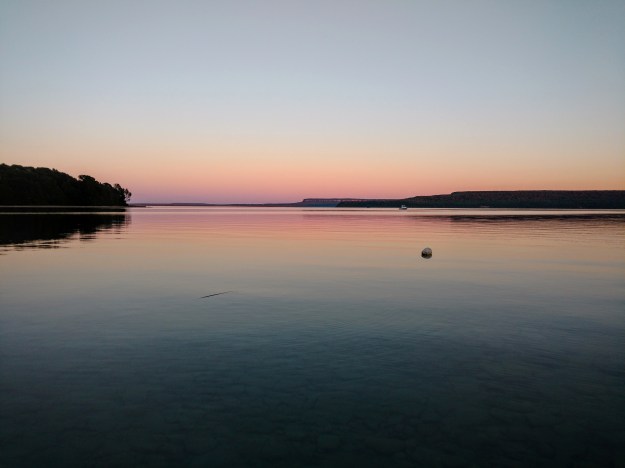
As I’ve gotten older, I’ve really started notice the crowds more. As an example, my famliy and I often spend time on the Bruce Peninsula in Ontario. There is a wonderful national park and fantastic hiking along the Niagara Escarpment. The first year we visited, 2004, the place seemed so remote, so pristine. But ever year, the crowds have steadily increased. So much so that one of the most popular attractions, “the Grotto” has summer restrictions now. It can only be accessed you are given one of the parking passes that are handed out at 7:00am each day. When the passes are gone, the park is closed to anyone without one. The Grotto is magnificent, but hard to enjoy when it’s teeming with people.

IMG_20160801_204000278

A quiet evening on the Bruce Peninsula, looking out over Georgian Bay

The traffic at the big American parks (Yosemite, Smokey mountains, Yellowstone) is legendary and a growing problem, In some parks, campgrounds are so popular that some entrepreneurs have set up permit bots to buy the site permits when they are available and resell.

Personal preference

So what makes some people crave a vacation in a crowded area and others choose solitude? Some people plan for big crowed locations like Disney, Las Vegas, or a music festival like Coachella or Osheaga. And of course, some events are crowded by nature, such as a ball game. I tend to want to avoid crowds (an ideal vacation is winter camping…crowds are low).

Maybe it comes down to what you want to get away from or back to? I work at a large research university and teach classes up to 200 students. With 30,000 students enrolled at Western, I find that I’m always in a crowd. I suppose the last thing I want to do to recharge is be in another crowd. But if you tend to work in a less crowded place, maybe the fun of being in a bigger crowd on the beach or a park is what you enjoy.

Vacations are needed

Regardless of whether you like a crowd, a beach, the city, or solitude, we all need some time to get out of our comfort zone (or sometimes time to get back into it). Project:Time Off tracks research on vacations and the general message is that we’re not doing it enough. I I hope you are able to get away for a few days. Unplug. Reconnect with your friends or family. Or head to a big crowded festival if that’s your thing (I won’t see you there…). Either way, enjoy your vacation!


Grade Inflation at the University Level

I probably give out too many As. I am aware of this, so I may be part of the problem of grade inflation. Grade inflation has been a complaint in universities probably as long as there have been grades and as long as there have been universities.

Harvard students receive mostly As.

But the issue has been in the news recently. For example, a recent story asserted that the most frequent grade (e.i. the modal grade) at Harvard was an A. That seems a bit much. If Harvard is generally regarded as of the world’s best universities, you would think they would be able to asses their students on a better range. A great Harvard undergrad should be a rare thing, and should be much better than the average Harvard undergrad. Evidently, all Harvard undergrads are great.

One long time faculty member, says that “in recent years, he himself has taken to giving students two grades: one that shows up on their transcript and one he believes they actually deserve….“I didn’t want my students to be punished by being the only ones to suffer for getting an accurate grade,”

In this way, students know what their true grade is, but they also get a Harvard grade that will be an A so that they look good and that Harvard looks good. It’s not just Harvard, of course. This website, gradeinflation.com, lays out all details. Grades are going up everywhere…But student performance may not be.

The University is business and As are what we make.

From my perspective as a university professor, I see the pressure from all sides, and I think the primary motivating force is the degree to which universities have heavily embraced a consumer-driven model. An article The Atlantic this week got me thinking about it even more. The article points out, we (university) benefit when more students are doing well and earning scholarships. One way to make sure they can earn scholarships is to keep the grades high. It is to our benefit to have more students earning awards and scholarships.

In other words, students with As bring in money. Students with Cs do not. But this suggests that real performance assessment and knowledge mastery is subservient to cash inflow. I’m probably not the only one who feels that suggestion is true.

And of course, students, realizing they are the consumer, sort of expect a good grade for what they pay for. They get the message we are sending. Grades matter more than knowledge acquisition. Money matters more than knowledge. If they pay their tuition and fees on time, they kind of expect a good grade in return. They will occasional cheat to obtain these grades. In this context, cheating is economically rational, albeit unethical.

Is there a better system?

I am not sure what to do about this. I’m pretty sure that my giving out more Cs is not the answer, unless all universities did this. I wonder if we really even need grades? Perhaps a better system would be a simple pass/fail? Or Fail/Pass/Exceed (three way). This would suggest that students have mastered the objectives in the course and we (the University) can confidently stand behind our degree programs and say that our graduates have acquired the requisite knowledge. Is that not our mission? Does it matter to an employer if a student received an A or a B in French? Can they even use that as a metric when A is the modal grade? The employer needs to know that the student mastered the objectives for a French class and can speak French. Of course, this means that it might be tricky for graduate and professional schools to determine admission. How will medical schools know who admit if they do not have a list of students with As? Though if most students are earning As, it renders moot that point.

In the end, students, faculty, and university administrators are all partially responsible for the problem, and there is no clear solution. And lurking behind it, as is so often the case, is money.